How to Become Ground Staff in India
December 10, 2025
Book Your Free Demo Class
How to Become Ground Staff in India — Complete 2025 Guide
The Indian aviation industry is rapidly expanding. New airports, fleet growth across legacy and LCC carriers, and rising domestic travel create a steady demand for trained airport ground staff. Ground staff roles are frontline, customer-facing, and operational — ideal for candidates seeking a stable career with clear growth paths. This guide gives you a step-by-step roadmap: eligibility, best courses, where to apply, interview preparation, salary expectations, and more.
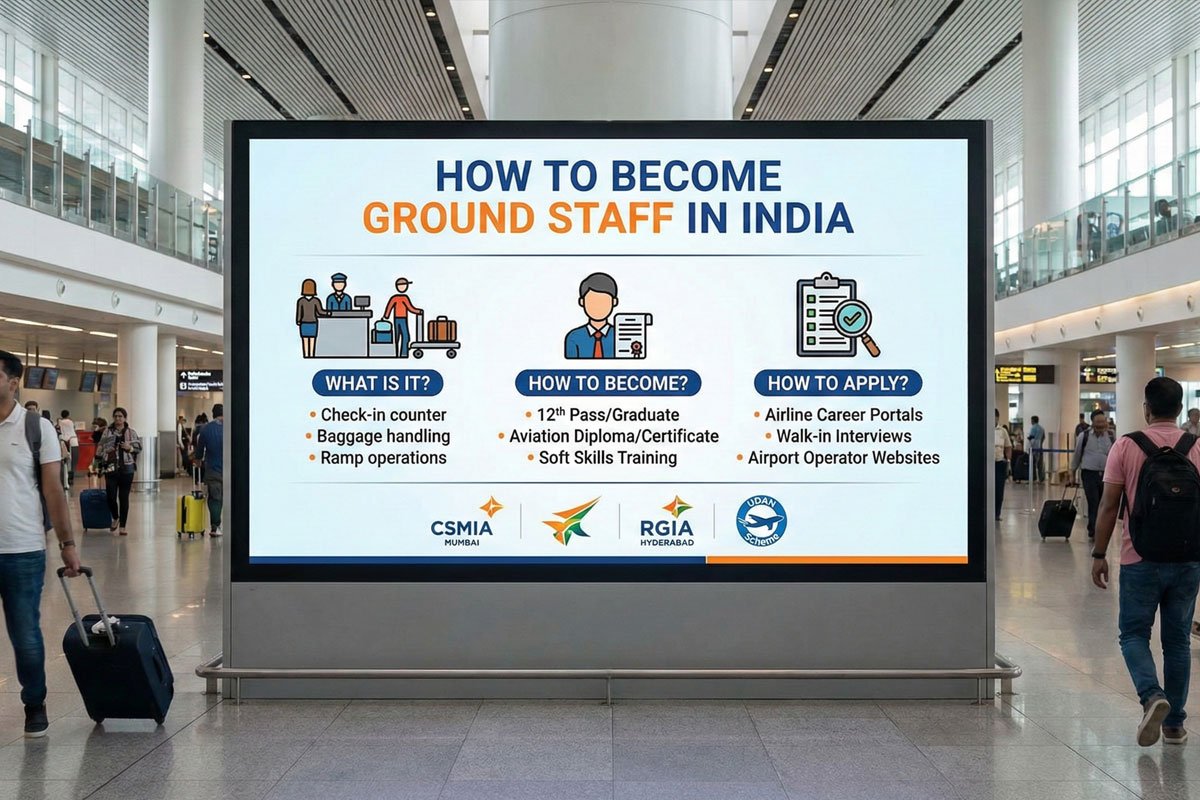
1. What is Airport Ground Staff?
Airport ground staff are the professionals who manage passenger operations, baggage processes, flight turnarounds, and terminal coordination. Their responsibilities vary by role but include check-in, boarding, baggage reconciliation, gate management, passenger handling, and coordination with ramp crews and flight operations.
2. Why India Needs More Ground Staff (2025 trends)
Key drivers increasing demand:
- Rapid runway and terminal expansion in metro and non-metro airports.
- Fleet growth and new airline entrants increasing flight frequencies.
- Government regional connectivity pushes (UDAN) bringing more airports online.
- Private ground handling vendors scaling operations to service multiple airlines.
Result: Regular hiring cycles at airlines, ground handlers and airport operators for ground staff positions.
3. Eligibility & Basic Requirements
Typical employer requirements:
- Minimum 10+2 (any stream) — most airlines require this as a baseline.
- Age: generally 18–27 for fresh recruitments (check specific employer notices).
- Good communication skills in English and local languages for regional hubs.
- Professional grooming, positive attitude and clear background verification.
4. Skills Employers Look For
Key skills that improve hireability:
- Customer service & complaint handling
- Basic computer literacy (MS Office, DCS/GDS familiarity)
- Teamwork and problem-solving under pressure
- Time management and punctuality
5. Best Courses & Certifications (which actually help)
While training is not mandatory, certified candidates often get shortlisted faster. Recommended learning options:
- Short-term certificates (4–12 weeks): GDS (Amadeus/Sabre), airline ticketing, DCS basics, customer service.
- Diploma programs (6–12 months): Airport ground operations, aviation management, hospitality basics.
- Cabin crew / air hostess courses: Useful cross-skill if you want lateral mobility or passenger handling expertise — see our Air Hostess Course in Mumbai.
Explore short certificates here: Aviation Certificate & Courses.
6. Where to Apply — Trusted Job Sources
Always apply via trusted and official channels:
- Airline career portals: IndiGo, Air India, Vistara, Akasa Air, SpiceJet.
- Ground handling partners: AIASL, Menzies, Celebi, SATS, TajSATS.
- Airport operators: AAI and private airport operators' recruitment pages.
- Job boards & professional networks: Naukri, Indeed, LinkedIn (follow airline & handler pages).
Tip: set alerts on LinkedIn and Naukri for “ground staff”, “customer service executive — airline” and “airport operations” to get quick notifications.
7. Interview Process & What To Expect
Typical rounds:
- Document verification and resume screening
- Group discussion (sometimes) or role-play
- Personal interview — scenario-based questions
- Grooming & etiquette check
- Medical test (vision, fitness)
Pro tip: For scenario questions, structure answers: Problem — Action — Result.
8. Salary & Career Growth
Salaries vary by airline, city and the ground handler. Approximate ranges (2025):
- Freshers: ₹18,000 – ₹28,000 / month
- 2–5 years: ₹30,000 – ₹45,000 / month
- Supervisory/Managerial: ₹50,000 – ₹1,20,000+
Progression often follows: Ground Staff → Senior Associate → Duty Officer → Assistant Manager → Airport Manager.
9. How to Prepare Your Resume (Aviation-friendly)
Your CV should be concise, 1–2 pages, and highlight aviation-relevant skills:
- Contact details + clear photo (passport-size, formal)
- Education + certifications (GDS, diplomas)
- Skills: customer service, DCS/GDS, MS Office
- Availability & preferred location
10. Ground Staff vs Cabin Crew — Key Differences
Many candidates confuse these roles. Quick distinctions:
- Ground Staff: Works inside airport terminals — check-in, boarding, baggage handling, operations coordination.
- Cabin Crew: Works onboard aircraft — safety demonstrations, in-flight service, emergency management.
Both roles demand customer service and grooming; cabin crew requires different medical and height criteria depending on airlines.
11. Top Recruiters in India (2025 Updated List)
Major organisations regularly hiring ground staff:
- IndiGo (InterGlobe Aviation)
- Air India
- Vistara
- Akasa Air
- SpiceJet
- AI Airport Services Ltd (AIASL)
- Menzies Aviation
- Celebi Aviation
- Airport Authority of India (AAI) — airport operator roles
Follow their careers pages and set alerts for entry-level hiring.
12. Common Interview Questions & Model Answers
Practice these with confident examples:
Q: Tell us about yourself.
A: “I completed 12th and recently finished a short aviation certificate in ticketing and customer service. I enjoy interacting with people, stay calm under pressure, and want to start my career in airport operations to develop strong operational skills.”
Q: How would you handle an irate passenger whose flight is delayed?
A: “First I would listen patiently to the passenger, acknowledge their inconvenience, provide clear information about the delay and the expected next steps, offer alternatives (rebooking/refreshments where applicable), and escalate to a duty officer if needed.”
Q: Give an example of teamwork in a stressful situation.
A: “In my internship, when a sudden flight cancellation occurred, I coordinated with colleagues to manage rebooking, arranged priority for elderly passengers and updated waiting lists — this reduced confusion and improved passenger satisfaction.”
13. Day in the Life of Airport Ground Staff
A typical day can include:
- Pre-shift briefing and roster check
- Counter opening and check-in assistance
- Coordinating boarding and ramp activities for active flights
- Handling passenger queries, special assistance and disruptions
- End-of-shift handover and incident logging
Shift work is common — morning, evening or night shifts depending on flight schedules.
14. Action Plan — 60 Days to Get Hired
- Days 1–7: Finalize resume, create LinkedIn & Naukri alerts for ground staff roles.
- Days 8–21: Enroll in a short GDS/ticketing certificate and practice mock interviews.
- Days 22–35: Apply to airline and ground handling recruiter portals; attend webinars and career fairs.
- Days 36–50: Attend walk-ins, follow up with recruiters, complete any short assignments.
- Days 51–60: Finalize offer, get medical check done and submit documents for onboarding.
15. Frequently Asked Questions (FAQs)
1. What is the minimum qualification to apply?
Minimum: 10+2. Having aviation certificates/diploma improves selection chances significantly.
2. Are short certificates useful?
Yes — GDS, DCS and ticketing certificates give immediate job-readiness and increase interview callbacks.
3. How much do ground staff earn?
Freshers earn ₹18k–₹28k monthly on average; salaries grow with experience and promotions.
4. Can I become cabin crew after ground staff?
Yes — with additional cabin crew training and meeting airline-specific medical & height criteria, many candidates move from ground roles to cabin crew roles.
Tags : Ground Staff | Airport Jobs | Aviation Careers | Airport Recruitment | Airline Ticketing